A message enters through one door and leaves with a verdict
NexusFabric takes a message at one of four doors — HTTP, queue, schedule or gRPC — passes it through the same access gate and the flow declared in a file, then leaves exactly one verdict in the journal.
Four doors, one gate
The gate is closed by default and runs before the body: an unauthenticated caller causes no body read and no parsing. Which door a delivery came in through is read from a journal column, not from the kind of the event.
How a message travels
The gate decides before the body
The request passes the gate before a single byte of body is read. A caller without a key gets a 401 and learns neither whether the flow exists nor how much body it would have been allowed to send.
The ceiling is resolved, then the body is read up to it
A message ceiling is resolved per access point, from three layers: the installation, the flow, the egress step. A body that exceeds it gets a 413 and leaves a
faultevent in the journal.Executor::deliveris the one bracketAll four doors enter through the same delivery bracket. Deduplication on a key, request-to-response correlation and response memoisation have no code of their own on any door.
The steps run in order
A
validateguard refuses at the first rule that is false, aroutepicks one arm and converges after the guard’s last arm, anntdfence produces the next document. An unhandled error enters the## Fault:section, if the flow has one.Exactly one verdict
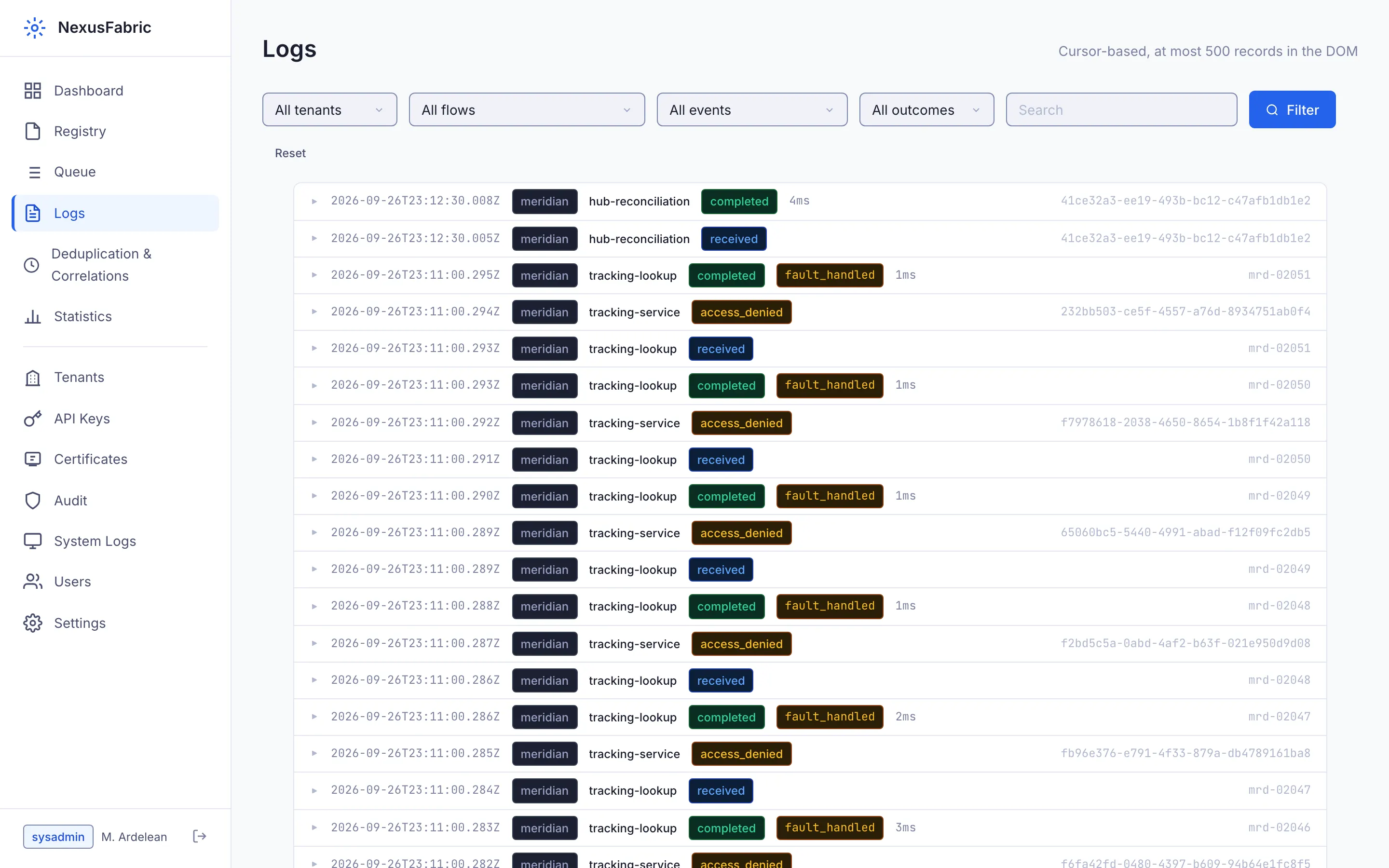
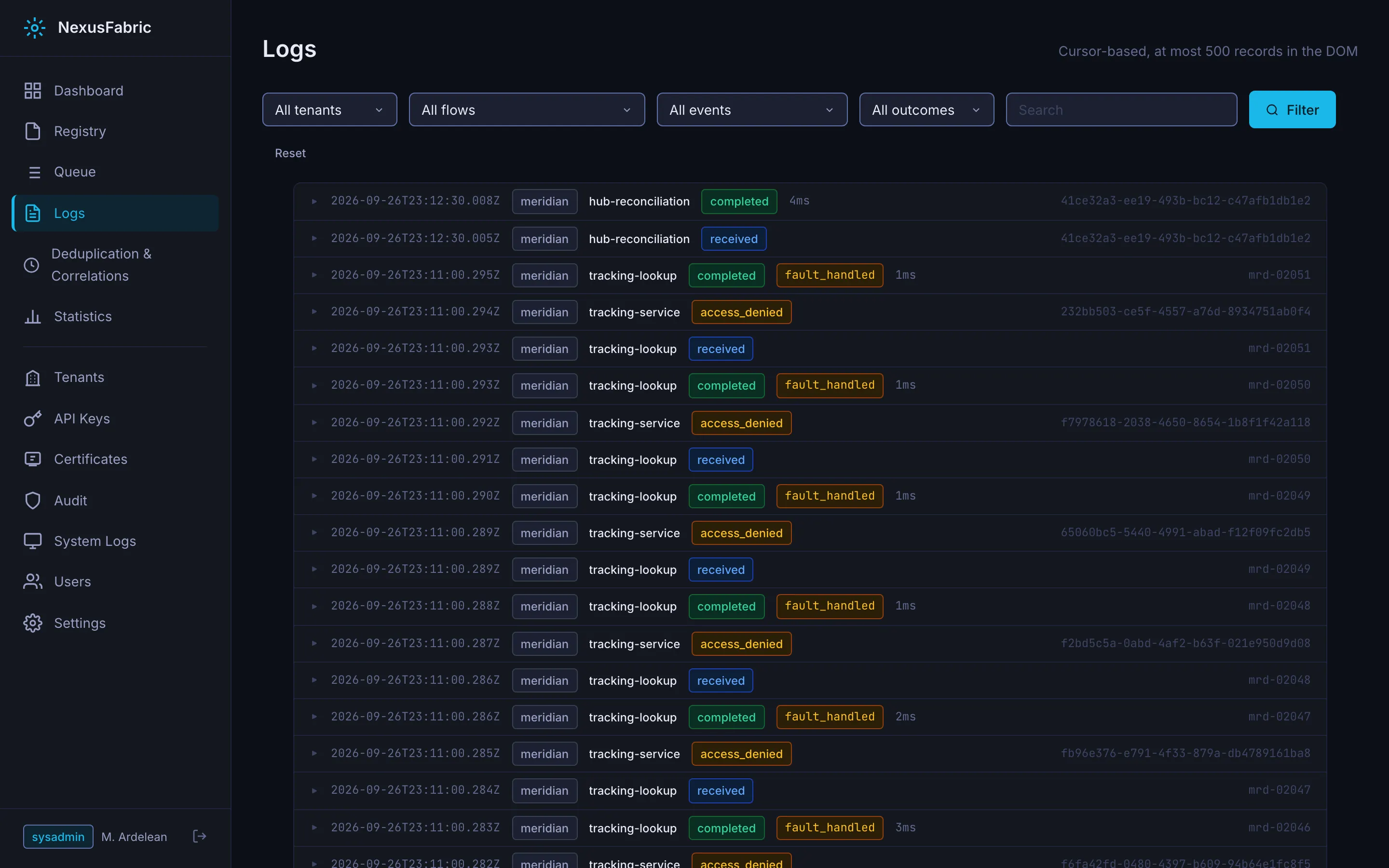
A delivery leaves a received event and exactly one verdict:
completed,faultordelivery_refused. The nuance sits on theoutcomecolumn beside it —succeeded,fault_handledorfailed.The journal says which door it came in through
The channel is a column, not a kind of event:
http,grpc,queueorcron. A schedule tick leaves the same received plus verdict pair as a synchronous request.
Read this diagram as text
- The caller sends the request to a flow route.
- The access gate decides first, and it is closed by default. Without a valid credential the request stops here, with a 401 or a 403, and leaves an
access_deniedevent. - The message ceiling is resolved, then the body is read up to it. A body over the ceiling stops with a 413 and reaches no step.
Executor::deliveris the bracket all four doors enter through. Deduplication and correlation are decided here.- The flow steps run in order.
- The delivery ends in a verdict, exactly one:
completed,faultordelivery_refused. - A refusal by the gate or by the ceiling goes straight to the journal, without touching the steps.
- The L1 journal records the received event, the verdict, the channel the delivery came in on, and the
outcomecolumn.
The file you write
A flow is a Markdown file: a header saying who owns it and which effects it may use, then steps. Guards, transforms and the response are written in fences, each with its own language. Below, two fences from a real flow in the compliance corpus: a guard that refuses explicitly, at the first rule that is false, and a step that declares its response status.
tests/battery/corpus/meridian/01-shipment-intake.flow.md — the egress step between the two fences, lines 34-40, is left out: it carries an endpoint the battery substitutes at run time.## Step: check-booking
```validate
$.shipmentId != null | "shipmentId is required" | syntactic
$.hubCode != null | "hubCode is required" | syntactic
$.parcelCount > 0 | "parcelCount must be greater than zero"
$.weightKg > 0 | "weightKg must be greater than zero"
```
…
## Step: acknowledge
response_status: 202
```ntd
{
"status": "ACCEPTED",
"shipmentId": "{{ $.echo.shipmentId }}",
"waybill": "{{ $.echo.waybill }}",
"hubCode": "{{ $.echo.hubCode }}",
"parcelCount": {{ $.echo.parcelCount }}
}
```What is counted
The figures below describe the shape of the product and are read from the code.
- 4doors a delivery arrives throughHTTP, queue, schedule and gRPC, all through one gate
- 10fence languages in a flow filetransform, guards, routing, loop, parallelism
- 23event kinds in the journaleach with an emission site required mechanically
- 25fields always maskedcannot be switched off; a flow can add to the list
- 16error variants in a single mapone exhaustive match, no catch-all arm
What it refuses to do
The limits sit here, next to the capabilities, so an unsuitable case can be ruled out on the first page.
- The queue delivers at least once. The platform does not promise exactly-once at the door; what it offers is declarative deduplication on a key written in the flow.
- It exports no metrics. What happened is read from the delivery journal and the management interface, not from a monitoring system.
- It does not encrypt at rest. The databases and the queue files are encrypted at the disk or volume level, not by the platform.
- The gRPC door serves unary methods. A streaming method gets an explicit refusal, not a silent degradation.
- The gRPC routing table is built at start-up. A flow published afterwards is routed at the next restart.
- Environment configuration is captured at start-up. A configuration change requires a restart, so that the start-up check covered exactly the values the platform is running on.
Coverage
| Protocol or effect | Inbound | Outbound |
|---|---|---|
| HTTP, JSON | synchronous on the run route, asynchronous on the enqueue route | HTTP call from a step |
| XML | the same doors, with an XML Content-Type | HTTP call, with an XML Content-Type |
| SOAP 1.1 and 1.2 | detected from the body; WSDL 1.1 generated on its own route | envelope composed on the egress step |
| gRPC | a separate door, unary methods | unary and server streaming, with TLS and mTLS |
| Schedule (cron) | a six-field schedule in the flow header | not applicable |
| Queue | the enqueue route, a log on disk, at-least-once delivery | queue publication from a step |
| JMS, over STOMP | a separate connector, handing over on the queue route | not built |
| Files in a directory | a separate connector, handing over on the queue route | not built |
| Secrets from the environment | not applicable | secret read from a step |
| OAuth2 client_credentials | not applicable | token acquisition from a step |
The platform, by chapter
- ProtocolsThe inbound doors, the outbound calls and the ceiling on a message.
- TransformationsThe flow language, the guards, routing, and what is refused at publication.
- ObservabilityThe measured unit, the verdict of a delivery, and the retention window.
- SecurityThe gate, the tenant, the interface roles, and what never reaches an error message.
Licence and version
- Version described here
- 1.2.0
- Licence
- Commercial, proprietary. No public download and no source code.
- Availability
- By contract, on request.